
Using Screen Cast-O-Matic In-Class
Cult of Pedagogy: Graphic Novels in the Classroom – A Teacher Roundtable

A Cult of Pedagogy features various Q&A’s from teachers discussing important novels to incorporate into classrooms. A question I reflected on was: 4) What Other Books Have You and Your Students Loved?
Throughout this reading, many teachers commonly agree that both the novels Persepolis (about a young lady living in Iran before and after the Islamic Revolution) as well as Maus (about the Jews and Nazis experiences of WWII, all while using cartoon mice and cats) are appropriate for the secondary level, and teach students about social justice in an interesting way. Other teachers even come together to share many of their classroom’s favourite Graphic Novels and put together a list while others add on to it with their favourites as well. Teachers appreciated the list mostly because it incorporates diverse representation. Many teachers express that they are constantly looking for “approachable, high-interest nonfiction graphic novels” and so this list is a perfect resource for teachers with that same interest. A novel by the name of “The Gigantic Beard That Was Evil” by Stephan Collins was recommended by one of the teachers, Michelle Falter, is a book that was mentioned and was new to me, but sounds rather interesting.
Podcast Response
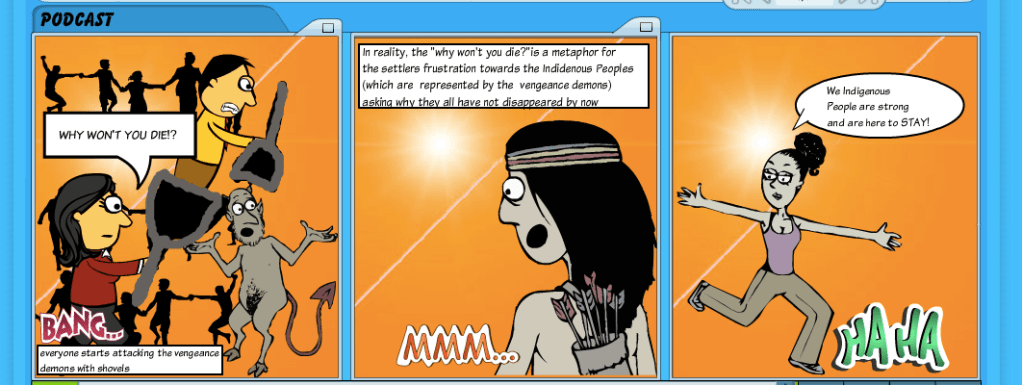
This is the comic I created using ToonDoo in response to the Buffy Podcast viewed in class. The quote “Why won’t you die” is in reference to the many settlers who tried exterminating the Indigenous peoples.
Reflection of Group-Presentations
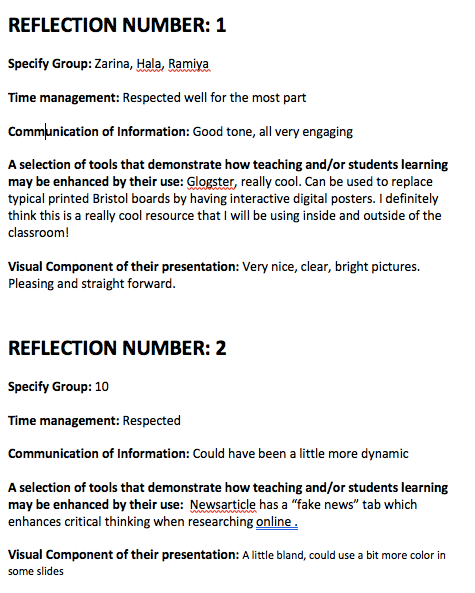
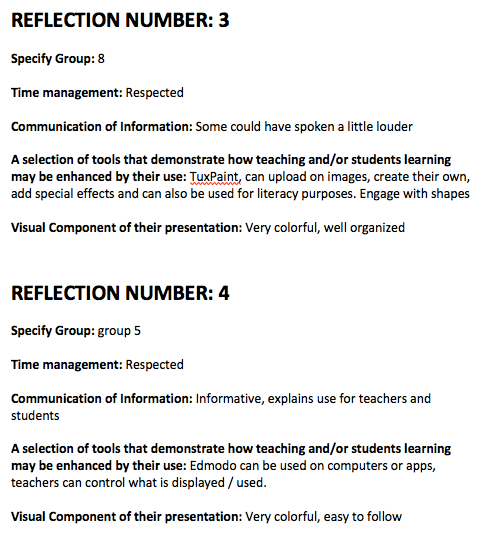

Racial Literacy
What is Racial Literacy and Why is it Important? Racial literacy is a way for members of society to be more understanding of others’ races rather than following what seems to be societal norm in order to improve worldwide communities and to be able to invest in others and their experiences. It is important so that people of various races do not feel as if they are excluded, neglected or lesser than other members. Unity will benefit generations upon generations by having closer-knit groups and a deeper understanding of various cultures.
How does Ulluci (2012) describe the “racial and cultural consciousness of being white”? The notion of colorblindedness is first mentioned in respect to white people being unaware of their privileges solely based on the color of their skin. This encourages them to not only not recognize their own powers, but instills great levels of disconnect between other teachers, peers, students and all other members of society. Their little experience with diversity encourages them to prefer students of their own kind which not only creates barriers inside of the classrooms, but teaches students that this is an acceptable way of acting. Whiteness is essentially associated with power. From this notion, all those who are not white are regarded as powerless. There is a pre-established superiority complex that is associated with white people, which is discouraging in peer groups, places of work, especially schools and other public sectors.
How does whiteness function in society? Schools are often tailored to white norms and therefore support the typical white middle-class traditions which essentially neglects other cultural groups. Many students of white backgrounds are so immune to their privilege that they themselves do not even recognize their advantages, nor believe they even have a culture of their own. This instills the idea that they part of a superior class, unwilling to mingle and mix with those less than them. On another note, while some whites believe they may not even have a culture, some pick and choose when they would like to display this culture. For white people, they are at an advantage as they can choose when they would or would not like to share aspects of their culture since it is not always visually obvious. This is a huge advantage as many are judges solely based on what they look like and therefore picking and choosing when they would like to display their culture is not even a choice. From this, whites have had an easier time creating social ties, feeling included and establishing lucrative family businesses.
TPACK Response
1.How do the authors establish their arguments that cellphilms are an educational technology?“Educational technology” = is “the study and practice of facilitating learning and improving performance by creating, using and managing technological processes and resources”. This definition is used by authors within their argument that cellphilms are an educational technology. TPACK is used by the authors to establish the educational impact of cellphilms. TPACK impacted the teachers by having them “shift from her or his possession of only the primary domains of knowledge to an inclusion of the hybrid domains and their eventual convergence in practice.” (p.12)
2. Why do the authors argue that cellphilms support teachers’ navigation of complex issues?Cellphilms allow complex issues to be addressed through personal conversations
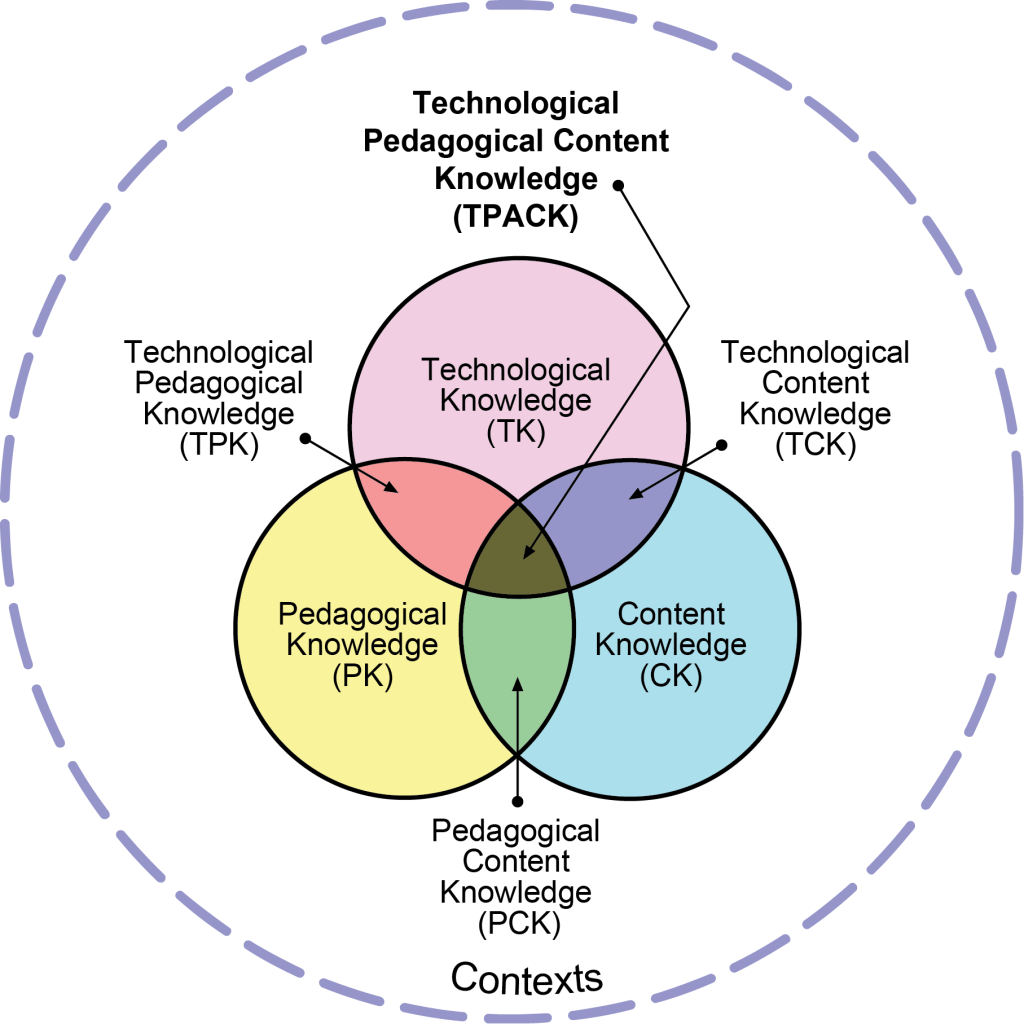
3. What are the various domains of TPACK? How do the authors connect DigitalVoices to each domain? Provide one or two points for 3 of these domains. TPACK is composed of three primary domains: Technological Knowledge (TK), Pedagogical Knowledge (PK), and Content Knowledge (CK). Followed by Technological Pedagogical Knowledge (TPK), Pedagogical Content Knowledge (PCK), Technological Content Knowledge (TCK), ad Technological Pedagogical Content Knowledge (TPCAK). Teachers engaged in cellphilm production in order to contribute to deepening an understanding of youth sexuality in relation to HIV and AIDS and applied a TPACK approach. In the first section, the researcher and teacher educator write about TPACK in order to frame teachers’ technological and pedagogical knowledge (TPK). The second section includes describing the fieldwork with rural teachers in South Africa in relation to youth sexuality and HIV and AIDS. (PCK). The last section brings their voices together in offering an analysis of cellphilm production (TCK) alongside an analysis of the value of TPACK as a model.
Comparison Assignment
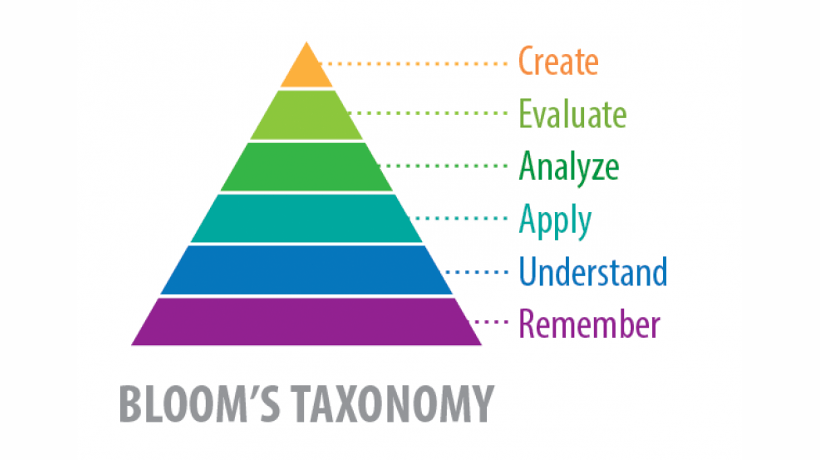
Bloom’s taxonomy and TPACK are two different concepts that help guide teachers and educators. Bloom’s taxonomy is divided in six different categories: create, evaluate, analyze, apply, understand & remember. These six categories are all equally important but are very different. Create signifies producing “new or original work”, evaluate signifies justifying “a stand of decision”, analyze signifies drawing “connections among ideas”, apply signifies using “information in ne situations”, understand signifies explaining “ideas or concepts”, and finally remember signifies recalling “facts and basic concepts”. Each of these concepts are layers one after another in a pyramid shape, which we believe signifies that these concepts build on one another.
TPACK on the other-hand is composed of three primary domains: Technological Knowledge (TK), Pedagogical Knowledge (PK), and Content Knowledge (CK). Followed by Technological Pedagogical Knowledge (TPK), Pedagogical Content Knowledge (PCK), Technological Content Knowledge (TCK), and Technological Pedagogical Content Knowledge (TPCAK). These domains are all intertwined and TPACK stands for the end results, where all the circles meet together in the middle to form a perfect blend of technology, pedagogy and content.
TPACK is more technologically focused than Bloom’s taxonomy when it comes to creating a classroom curriculum. We believe that both of these resources will be beneficial to us in our careers as educations, but we tend to favor Bloom’s taxonomy. Given how general and easily applicable Bloom’s taxonomy is when it comes to creating a curriculum, we believe that it would support us more as new emerging teachers.
Part 2:
In your own words, describe what does Dahya (2017) means by “problematizing ‘voice’ in youth digital media production”?
Dahya tries to explain that the voices portrayed on media platforms often stream from dominant groups, which marginalize minorities, leaving them with little to no room to participate.
In your own words, describe the case study this article is discussing
This case study explores the role of Canadian girls who are all of color with the majority being Muslim. Muslim-Canadian girls face biases on a daily basis and are among one of the most discriminated against in Canada. Relating to the article, they face “discrimination based on class, race, gender, and for Muslim girls, religion.” (103).
This case study looked at 16 girls from the 2011-2012 girls’ media cub. Dahya pays closer attention to three girls named, Salima, Nadia and Ananra. These girls use technology in many different ways: making videos, making short pixilation, working with iPads and laptops. The three girls felt clueless and insecure when it came time to actually work with the technology and see themselves on camera. Most of the girls found videos of themselves “ugly” (104) and “embarrassing” (104). Some of the girls remembered being publically embarassed for showing signs of religious expression and shamed for doing so. Since the girls personally related to being bullied, they often chose bullying as a central theme to theri assignments.
What conclusions does Dahya make about youth making media in certain contexts?
Dahya suggests that as memebers of society, we must collectively move past ideas of “giving voice” to the upper-class memebers of society, realizing that race, religion, ethinicity, class, and gender on a daily basis and especially when working with technology. She concludes by asking: “How do we define and refine the tone, pressures, and expectations associated with particular media forms in the process of engaging young people in digital production? How do we continue to build on creative, digital visual research and production in educational settings to better under- stand how those artifacts are shaped?” (108)
What kind of connections can be made between this article and the concept of racial literacy?
As a reminder, racial literacy is a way for members society to be more understanding of others’ races rather than following what seems to be societal norm in order to improve worldwide communities and to be able to invest in others and their experiences. It is important so that people of various races do not feel as if they are excluded, neglected or lesser than other members. Unity will benefit generations upon generations by having closer-knit groups and a deeper understanding of various cultures.
In this article, it can be seen that a few young girls are trying to work with media in their classroom setting and produce videos.
One of the Muslim girls, Salima, is discriminated against when she is called ugly and a man suggests that she should simply get rid of her head scarf. As consequence, her self-worth depletes and she decides to completely get rid of the video she initially tried producing. She believes she is ugly, does not fit in and that her work holds less meaning due to her religion. She is comparing herself to the opinions of people who are not racially literate and so not understand the importance of mulit-culturalism. When people are not racially literate and unaccepting of others, it imposes negative consequences on the individuals self-esteem, confidence and creativity.
What are some connections that might be made for teachers between TPACK, racial literacy, and student-led production? How can these connections be linked to broader issues around media literacy? Provide examples.
TPACK influences teachers and students to incorporate the use of technology for learning purposes. As such, when considering TPACK, racial literacy and student-led production, it is important that memeber are aware of the implications of what they produce and how memebers of the public may percieve their work.
When Salima produced her video, she experiences issues with video editting since she never recived the proper education on how to edit videos or how to really use technology in an educational setting, when some of the other peers have. This highlights the importance of teaching technology in classrooms so that students can feel as though they are at the same pace as their peers and work confidently with others.
Additionally, when Salima experienced racism and negative remarks concerning her choice of representing her religion, this brings up racial literacy and student-led production. Students should be mindful that not everyone will share the same ideas as them, and that they cannot always be pleasing everybody. However, racial literacy should also be addressed in schools and should also be taught to the public through educational videos in order to enhance people’s ideas of the world and promote safer environments.
 EDEC 262